
For years, restaurant delivery looked like a binary decision: you were either in the game or out. To get in, you listed your menu on a third-party marketplace, swallowed the 20% to 30% commission, and prayed that sheer volume would somehow offset the devastating blow to your margins. For a long time, the industry treated gross sales as the ultimate metric of digital success, ignoring the structural flaws of relying purely on food delivery marketplaces.
By 2026, that approach looks incredibly primitive. High inflation, skyrocketing labor costs, and changing consumer habits have exposed the flaws of over-reliance on a single channel. The modern playbook has evolved into a sophisticated, multi-layered restaurant delivery strategy: marketplaces for discovery, direct ordering for retention, and white-label delivery for restaurants looking for brand control and optimized economics.
This shift is not theoretical. Forward-thinking operators no longer view delivery as a monolithic revenue stream. Instead, they manage it as a portfolio of restaurant delivery channels, evaluating performance strictly by contribution margin. The true cost of delivery is no longer just the headline commission; it now encompasses paid visibility, marketplace promotions, platform service add-ons, and the operational friction of managing fragmented systems. To survive on razor-thin margins, businesses are forcing their technology to work harder, moving away from a single aggregator toward comprehensive owned delivery channels.
While a third-party delivery vs direct ordering analysis shows that aggregators are not going away, they have been stripped of their status as the total digital solution. The early marketplace era functioned on an unsustainable premise: restaurants traded their customer data, brand loyalty, and profit margins for pure convenience.
Today, the hidden costs of that trade have become too high to ignore. Restaurant delivery marketplaces have evolved from simple delivery fleets into aggressive ad-driven ecosystems. Listings that used to be organic now require sponsored spending just to maintain baseline visibility on third-party delivery apps. When you factor in the promotional discounts platforms demand to qualify for premium placement, the actual cost of an order often erodes any real profitability.
Furthermore, relying entirely on a third-party app means the restaurant is completely disconnected from its guests. When a consumer orders a burger through an aggregator, they are that platform's customer, not the restaurant’s. The platform captures the email, tracks the purchasing behavior, and uses that exact data to advertise a competitor's burger next Sunday.
Because of this, the industry conversation has shifted entirely. It is no longer about getting listed on every available app. The core of a modern restaurant's online ordering strategy centers on a much healthier question: "How do we maintain structural control over our demand, our data, and our fulfillment costs to remain profitable?"
Layer 1: Marketplaces as Paid Demand Capture
To build an effective delivery stack, operators must first redefine the role of major aggregators. Platforms like DoorDash, Uber Eats, and Grubhub remain vital tools, but their primary utility has shifted from fulfillment to top-of-funnel customer acquisition for restaurants.
The DoorDash Marketplace continues to dominate the U.S. digital landscape, while the Uber Eats marketplace maintains a massive, high-income user base across both the United States and Canada. These platforms possess millions of active users who open the apps with high purchase intent but zero brand commitment. They are looking for "sushi near me" or "fast dinner," making these apps powerful platforms for restaurant discovery.
[ Top of Funnel: Marketplace Discovery ]
│
▼ (First-Time Order / Acquisition Paid)
[ Middle of Funnel: Direct Conversion via CRM/Loyalty ]
│
▼ (Repeat Order / First-Party Margin)
[ Bottom of Funnel: White-Label Logistic Fulfillment ]
Smart operators now treat marketplace commissions as an acquisition cost rather than a permanent operational expense. The goal is to capture the first-time buyer via marketplace discovery for restaurants, deliver a flawless product, and immediately build a digital bridge to coax that guest into a direct, first-party channel for their second and third orders. If a guest orders from you through an aggregator five times a month, you are repeatedly buying the same customer at a premium price. That is a failure of your direct ordering strategy.
Layer 2: Direct Ordering for Customer Ownership
Implementing direct online ordering for restaurants forms the foundational core of operator leverage. When a guest places an order directly through a restaurant’s proprietary website or native mobile app, the financial and operational dynamics change instantly.
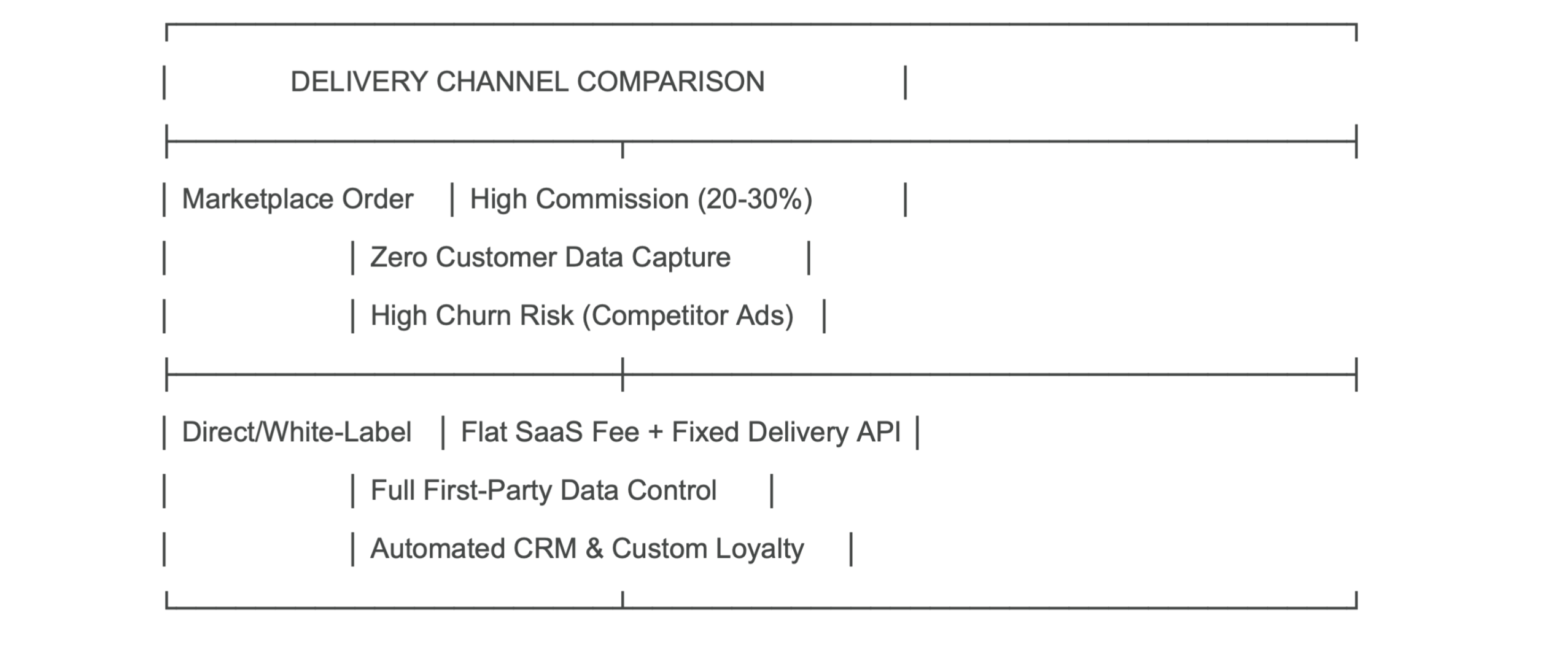
By bypassing marketplace intermediaries, the brand keeps the lion’s share of the transaction value, replacing percentage-based commissions with predictable, flat software fees. More importantly, direct ordering for restaurants secures total ownership of the customer relationship.
A modern online ordering system for restaurants is no longer just a basic checkout menu. It has evolved into a highly sophisticated commerce layer integrated with robust CRM software, personalized loyalty programs, and dynamic menu-management systems. When an order is placed through a first-party restaurant ordering channel, the business captures crucial data points:
- Precise order frequencies
- Direct communication preferences
- Specific dietary habits
- Average ticket sizes based on custom upsell prompts
With this data, automated marketing engines can trigger highly targeted, personalized offers without human intervention, turning one-time users into repeat customers that restaurant delivery channels depend on. With a built-in restaurant loyalty and direct ordering loop, a restaurant stops renting its audience and starts building permanent digital equity.
Layer 3: White-Label Delivery for Controlled Logistics
The most significant operational evolution in the stack involves white-label delivery for restaurants. Historically, if a restaurant wanted to build its own first-party restaurant ordering channel, it faced a painful logistical dilemma: either hire, maintain, and manage a proprietary fleet of drivers or force customers to pick up the food themselves.
Choosing white-label delivery completely decouples the digital ordering interface from physical logistics. The customer interacts entirely with the restaurant’s branded website, enjoys a customized user experience, and remains within the brand’s digital ecosystem. However, when the order is sent to the kitchen, a dispatch API instantly calls an underlying delivery-as-a-service for restaurants network — such as Uber Direct for restaurants or DoorDash Drive for restaurants — to handle the actual delivery.
The customer receives a branded tracking link, the food is delivered by a professional courier network, and the restaurant pays a predictable, fixed flat fee per delivery instead of a painful percentage of the total check. Comparing DoorDash Drive vs DoorDash Marketplace makes the benefits obvious: operators get the scale of a massive fleet without losing their margins to marketplace commissions.
This architectural approach is perfectly illustrated by modern delivery orchestration and POS integration providers. Tech stacks are now intentionally designed to segregate incoming restaurant delivery channels:
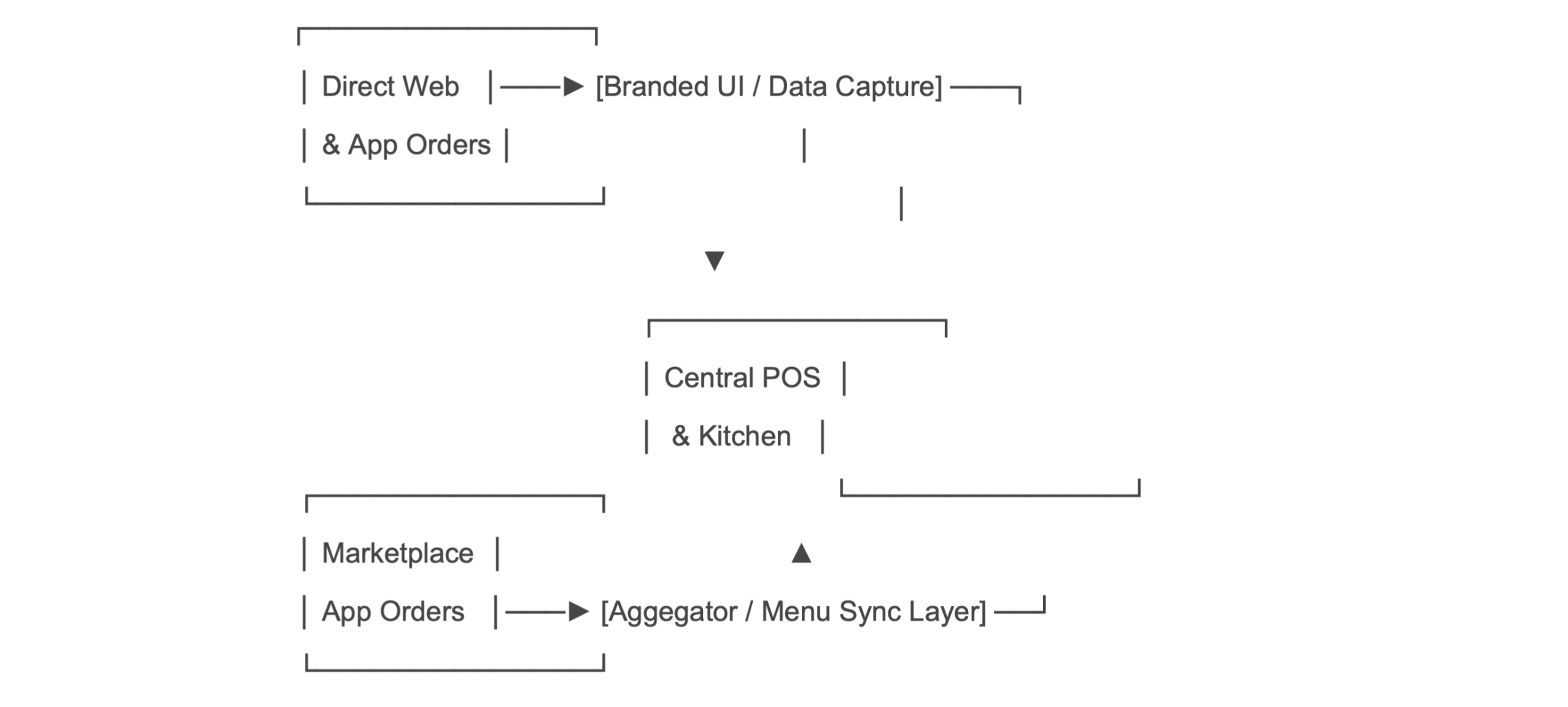
In this setup, marketplace orders are quietly consolidated, transcoded, and pushed straight to the kitchen display systems alongside first-party traffic, minimizing tablet clutter. Meanwhile, the valuable direct traffic routes through a high-margin pipeline where the restaurant retains control over both the brand experience and the underlying financial data through modern first-party delivery fulfillment.
For Point of Sale (POS) VARs, software developers, and integration providers, this shifting landscape fundamentally changes the B2B sales narrative. The era of selling simple, standalone middleware that merely "connects a tablet to a printer" is officially over. Restaurants are drowning in disconnected software tools that create fragmented data silos, bloated tech stacks, and operational blind spots.
The real modern opportunity lies in becoming an architectural consultant who helps operators build and enforce automated channel rules within their restaurant's online ordering strategy. Providers must deliver platforms that empower restaurants to manage their delivery stack based on clear, real-time logic:
IF Customer = First-Time Discovery ───► Route via Marketplace (Accept Commission)
IF Customer = Repeat Inbound ───► Route via First-Party UI + White-Label API
To support this, reporting layers must become vastly more intelligent. Restaurant operators do not need another dashboard that simply shows an aggregate number of orders. They require clear, channel-level visibility that breaks down accurate contribution margins by source, tracking the exact profitability of third-party delivery vs direct ordering options.

Software that exposes exactly where money is being made or lost across the tech stack shifts a provider from an easily replaceable utility expense to an indispensable operational partner helping restaurants scale their owned delivery channels.
The absolute strongest operating model is an intentionally managed hybrid architecture. Total reliance on food delivery marketplaces destroys a restaurant's margins; total isolation from them severely limits its discovery and audience growth.
A diversified delivery stack acts as an essential strategic hedge against platform dependence. If an aggregator suddenly alters its search algorithms, hikes its baseline fees, or charges more for essential visibility on third-party restaurant delivery apps, a brand with a strong foundation in direct online ordering for restaurants will not face a catastrophic drop in revenue. It retains an insulated pool of direct customers, an independent data repository, and a reliable white-label delivery logistics network to sustain long-term profitability.
Success in the delivery sector is no longer determined by who offers the most random digital ordering options. The winners are the disciplined operators and tech providers who build unified, multi-layered systems that optimize restaurant delivery fulfillment and extract maximum value from every channel without sacrificing their core margins.